


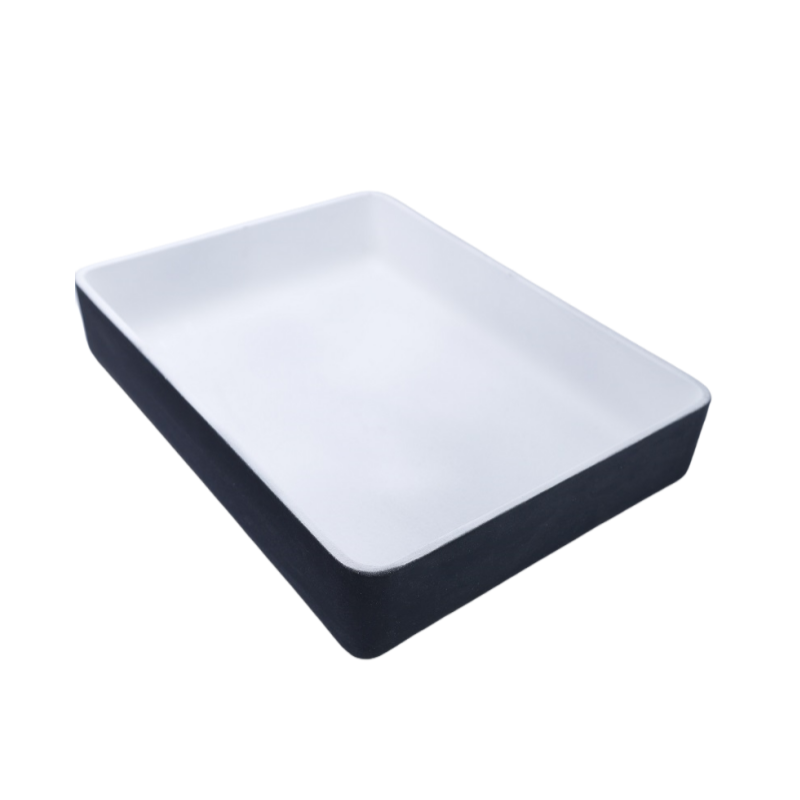
If we compare silicon carbide ceramics to a building, then silicon carbide particles are the "bricks" that make up that building. The size, shape, and arrangement of the bricks directly determine whether the building is sturdy, well-insulated, or aesthetically pleasing. Similarly, the particle size, morphology, purity, and distribution of silicon carbide particles fundamentally influence the final material's performance.
Today, let's talk in simple terms about how this "invisible commander"—silicon carbide particles—steers the fate of materials.
1. Particle Size: A Performance Spectrum from "Rugged" to "Refined"
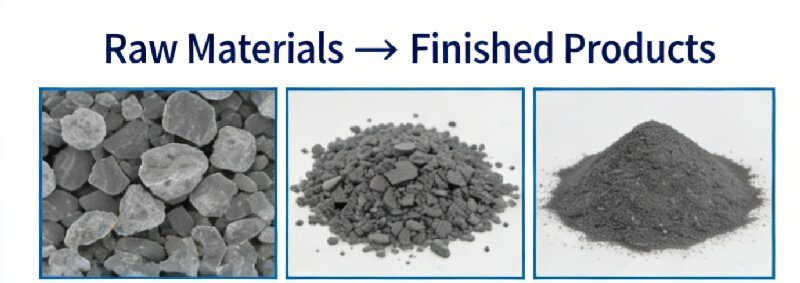
The particle size of silicon carbide can range from nanometers (<0.1μm) to millimeters. Different sizes give materials different "personalities."
Coarse Particles (>100μm)
Characteristics: Act as a skeleton, providing thermal shock resistance and toughness
Applications: Recrystallized silicon carbide kiln furniture, refractories
Simple Analogy: Like gravel in concrete, providing structural support
Fine Particles (1-100μm)
Characteristics: Fill pores, increase density and strength
Applications: Reaction-bonded silicon carbide, pressureless sintered silicon carbide
Simple Analogy: Like sand, filling gaps between the gravel
Ultrafine/Nano Particles (<1μm)
Characteristics: Promote sintering, enhance hardness and wear resistance
Applications: High-precision sealing rings, semiconductor components
Simple Analogy: Like cement, bonding the sand and gravel into a unified whole
Key Point: A single particle size often falls short. Multi-modal particle size gradation—the reasonable combination of coarse, medium, and fine particles—is necessary to achieve optimal performance, just as concrete requires gravel, sand, and cement mixed in proper proportions.
2. Morphology: Blocky, Flaky, Spherical—Each with Its Role
The shape of particles is not random; it directly influences the material's forming behavior and final properties.
| Morphology | Characteristics | Impact on Performance |
|---|---|---|
| Equiaxed/Blocky | High packing density, good flowability | Improves material density and strength |
| Flaky/Plate-like | Anisotropic, bridging effect | Enhances thermal shock resistance and fracture toughness |
| Spherical | Best flowability | Suitable for slip casting, spray coating processes |
| Acicular/Angular | Strong mechanical interlocking | Increases green body strength and wear resistance |
Simple Analogy: Blocky particles are like bricks, stacked neatly; flaky particles are like tiles, layered overlapping; spherical particles are like marbles, rolling into gaps. Depending on process requirements, we need to select the appropriate "shape combination."
3. Purity: Impurities Are "Invisible Enemies"
Silicon carbide itself has excellent properties, but impurities can erode material performance like termites.
Oxygen Content: Excessively high levels form a silica glass phase that softens at high temperatures, reducing creep resistance
Free Carbon: Affects sintering activity, potentially increasing porosity
Metal Impurities (Fe, Al, Ca, etc.): May form low-melting-point phases at high temperatures, causing deformation or corrosion
Key Point: For high-end applications like semiconductors and precision ceramics, silicon carbide particle purity requirements can reach above 99.9995%. In traditional sectors like metallurgy and refractories, purity requirements are relatively looser, but cost control is more critical.

4. Particle Size Distribution: Uniformity Is Essential
Even if the average size is "5 microns," performance varies greatly if some particles are 1 micron and others 10 microns.
Narrow Distribution: Uniform particle size leads to consistent sintering shrinkage and stable product dimensions
Wide Distribution: Smaller particles fill gaps between larger ones, resulting in higher packing density but more complex sintering behavior
Simple Analogy: Like sifting sand—if the grains are uniform in size, the sifted sand flows well and packs densely. If sizes are mixed, "bridging" can occur, affecting forming quality.
Silicon carbide particles—seemingly insignificant powders—are the "first checkpoint" in determining material performance. From particle size distribution to morphology, from purity control to gradation design, each parameter is like a precise "formula" requiring repeated tuning and optimization by researchers.
[Contact us to Inquire or Order] or [Call Our Hotline].
